Persecution
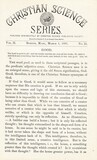
Originally published in the March 1, 1891 issue of the Christian Science Series (Vol. 2, No. 21)
“Blessed are they which are persecuted for righteousness’ sake: for their’s is the kingdom of heaven.”—Matt. v. 10.
Science and Health (New Ed.) 14, 457, 32, 334
...We read how the world was bound with the iron bands of materialism when Jesus came. How is it to-day? It has advanced, it is true. But is it in any adequate degree living in the bright Light of the gospel of Jesus Christ? If it were, would we see about us, on all sides, temples of worship which stand cold, stately, formidable, and forbidding during six days of the week, presenting an appearance of life and activity only one day in seven? Would the ministry sneer at the declaration that the sick can be healed through the power of God to-day, as well as in the days gone by? What does the word ministry mean? It means not the performance of sacerdotal rites, and the formal offices of priesthood; but it means the ministering to—the doing for—one’s fellow-man in the fullest measure. Jesus was such a minister. He was indeed a minister of the Gospel—an active spreader of the Good-spell, as this word means. He was not only a preacher, but a teacher and a healer; and so should his disciples be, as well now, as when he was in the flesh. If we were living in the broadness of the Light, we would see a world of unity and harmony, instead of a world of clashings, jarrings, and discordant elements.
We read in history of the, apparently, insurmountable obstacles which the early Christians had to overcome. We see how bravely and effectually they overcame as they remained true to the Master. We see how rigidly they held to the courage of their convictions, through all the trying circumstances under which they labored. We see that they preferred persecution to cowardice; death to apostasy; burning at the stake to betrayal of the Christ. We see that they were thoroughly imbued with the consciousness that they were working out, upon earth, a mighty Principle. They felt the presence of their Divine Master, and were conscious that God was their strength and their reliance, “their ever present help in time of need.” Thus knowing, what was martyrdom to them? In the fulness and simplicity of their faith, death had no terrors for them; and they were ready to exclaim with Paul:—”O death where is thy sting? O grave where is thy victory?” Their persecutions were at once their pride and their inspiration. They remembered the persecutions of their leader; they remembered his sufferings in Gethsemane; they remembered the cross; they remembered the persecutions and sufferings of the Apostles. What cared they, the true and genuine ones, for martyrdom? Their great care was to so watch, live, and pray, as to avoid the suicidal death of Judas Iscariot. It is for us, amid our little persecutions, which are not, and never will be worthy of mention in connection with theirs, to take lessons of them; to profit by their grand example, as well as the yet immeasurably grander one of their, and our, great Exemplar.
There were schisms amongst the early Christians. Many of them, like some who assume the name of Christian Science now, undertook to harmonize the religion of Christ with the religion of Buddha, but they failed. Others sought to destroy the personal Jesus, and they soon passed away. We see a repetition of this to-day. We see how Luther, and Calvin, and Zwingli, with their heroic band of co-workers, broke the power of Romanism at a time when such a task seemed utterly beyond the grasp of human achievement. Grand have been the achievements of Christianity since its era began. We have seen its banner borne aloft with heroic bravery, only again to fall almost out of sight in the depths of human selfishness. We have seen its star lighting up the world’s horizon, only to almost sink out of sight in the debris of human depravity. It has alternately blazed forth with the effulgence of Spiritual understanding, and almost disappeared in the gloom of material ignorance. How was the horizon, when the reformation of this century dawned upon human consciousness? Was there need of greater Light? Were there no clouds of darkness floating across that horizon obscuring the Light? Is Christianity now justified in sitting down in complacent self-righteousness, and folding its arms in the belief that the kingdom of God has come upon earth; that the mission of Jesus, and the apostles, has been fully accomplished; that his religion has become an easy-going thing of fashion and intended only for the Sabbath? Is there not need of a re-awakening? Have the thunderings and lightnings of Sinai, and Horeb, and Calvary died away forever? Have they no longer any meaning for the world?
The mighty problem of the Christ has not yet been solved in the world. The curtains have not yet fallen on the tragedy of the cross. The voice of Truth yet has meaning for mankind: “Blessed are they which are persecuted for righteousness’ sake: for their’s is the kingdom of heaven. Blessed are ye, when men shall revile you, and persecute you, and shall say all manner of evil against you falsely, for my sake” [Matt., v: 10, 11 ], This is the persecution we shall have to suffer. This is the martyrdom we shall have to undergo; the martyrdom of calumny; the martyrdom of malice; the martyrdom of cold disdain; the martyrdom of misjudgment and of misrepresentation; the martyrdom of the scorn and contempt of our modern scribes and Pharisees. Shall we be martyrs? Shall we be heroes? Shall we stand for the theology Jesus taught? Shall we stand out boldly in the Christ-Light of honest conviction, or shall we attempt to hide in the subterranean depths of mortal cowardice, as some of the early Christians sought to hide in the Catacombs of Rome? Nay, rather, let us each and all say with Paul:—“What shall we say then to these things? If God is for us, who can be against us?… It is God that justifieth. Who is he that condemneth?… Who shall separate us from the love of Christ? Shall tribulation, or distress, or persecution, or famine, or nakedness, or peril, or sword? As it is written, For thy sake we are killed all the day long; we are accounted as sheep for the slaughter. Nay, in all these things we are more than conquerors through him that loved us. For I am persuaded, that neither death, nor life, nor angels, nor principalities, nor powers, nor things present, nor things to come, nor height, nor depth, nor any other creature, shall be able to separate us from the love of God, which is in Christ Jesus our Lord.” Rom. viii: 31-39.