


Are you sure?
This bookmark will be removed from all folders and any saved notes will be permanently removed.
For all things are yours
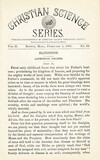
Originally published in the February 1, 1891 issue of the Christian Science Series (Vol. 2, No. 19)
Paul asks the Romans, “how shall he not with him also freely give us all things?” In Genesis it is stated that God gave unto man “dominion over the fish of the sea, and over the fowl of the air, and over every living thing that moveth upon the earth.” To us, as to the Corinthians, the apostle says “all things are yours,” yet we seem restricted: there seems so little really possessed even by those apparently gifted in every respect, according to the world’s estimate. Though one have much Spirituality; though he be ever so intellectual, and have much of the goods of this world—even he, we can plainly see, is far from having “all things,” and far, indeed, from having “dominion over all the earth.” When even the most gifted seem to lack so much, how can we believe the statement of the apostle in our caption!
As we read the Bible, we must learn to read with discernment; we must go further, and, in our daily life learn to separate the holy from the unholy, the clean from the unclean, in order that we may live the one and reject the other. Within the consciousness of every mortal, there are apparently two antagonistic influences or powers whose declarations are ever asserting themselves. We must learn to discern the voice of Truth that is ever speaking to us, from error that is ever at the heel of Truth, and insinuating itself into our consciousness. How are we to discriminate between the two? There is only one way, and Jesus marked out that way. It is to go to the Word of God, and see what is there written; that is, find out what really is the Word of God. The three times that error, suggested itself to the consciousness of Jesus, he met it by the declaration, “It is written,” and then affirmed the truth or spiritual fact already asserted by holy men and Prophets of old. Then the devil left him for a season, and angels ministered unto him; that is, ideas of Truth, of the great fact of his real, spiritual existence, came into his consciousness, feeding and sustaining him. We, likewise, should see what “is written;”' should learn what the Word of God is, in order to meet the temptations of error with a declaration of Truth. When in Scripture we find it written that God is the only Creator, and that He gave man dominion over the works of His hand, we have found a declaration of Truth that will stand forever; one written by holy men of old; one on which Jesus founded his great demonstrations, and upon which we also should plant ourselves. Both reason and common sense tell us that this is still the great spiritual fact; that if it seems altered, vitiated or annulled, the seeming is only due to our finite sense of things—to the ignorance within our consciousness. Paul expressed the same thought when he said, “Having the understanding darkened, being alienated from the life of God through the ignorance that is within them, because of the blindness of their heart.” So, it is the ignorance within us, the blindness of the heart, that denies us the liberty of the children of God, our rightful dominion over all things, and peaceful living in harmony and love.
Enjoy 1 free Sentinel article or audio program each month, including content from 1898 to today.
JSH Collections
This article is included in:
1891 - PAMPHLET
Christian Science Series, Vol. 2, No. 19
JSH-Online has hundreds of pamphlets, anthologies, and special editions for you to discover.
