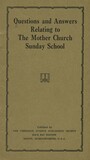
Questions and answers relating to The Mother Church Sunday School

Originally published in the 1939 pamphlet “Questions and answers relating to The Mother Church Sunday School”

QUESTIONS AND ANSWERS: Relating to the work of the Sunday School of The Mother Church

These questions and answers are prepared in reply to the many inquiries, verbal and written, which have come to The Christian Science Board of Directors and to The Mother Church Sunday School as to how the Sunday School is conducted. The Board of Directors is glad to give this information to inquirers, but does so without desiring or intending to influence the branch churches and societies in the conduct of their Sunday Schools. It should be understood that these answers set forth the practice in The Mother Church Sunday School, but that they are not mandatory for branch organizations.


1. What does The Mother Church Sunday School teach regarding “Remember the Sabbath Day”?

It stands for an observed Sabbath. While the teachers do not dictate to the pupils what they shall or shall not do on the Sabbath, they strive to bring to the attention of each pupil that it is his privilege and duty as a Christian Scientist to help to lead the world by example to more consecrated living on this day.

2. Do you have an examining committee to question the new pupil?

No. A new pupil is asked at the Secretary's desk, in as informal and kindly a way as possible, his name and address, the name of the church or Sunday School he has previously attended, and his age. The first impression is very important, and so it is the endeavor to ask these questions in a manner to avoid self-consciousness on the applicant's part, to have him feel a warm welcome and understand that here he will learn about God.

3. At what age may a pupil enter The Mother Church Sunday School?

When he is ready to be away from his mother and able to sit in a chair. Our Sunday School has pupils under two years of age.

4. In what class is the new pupil placed?

With pupils who are near his age.

5. Does he enter a class of beginners?

There is no such class. It is believed that the pupil gains the inspiration of Christian Science more quickly if placed with those who are of approximately his age, and that these pupils are benefited by helping the new pupil in the “first lessons.”

6. Do you find that it holds the class back to have a beginner placed in it?

No. It quickens the class to impart its understanding to the newcomer. In many instances the beginner leaves the class on the first day, inspired to know God, as are the others.

7. Does The Mother Church Sunday School admit visiting children?

Any one under twenty years of age who is a Protestant may attend The Mother Church Sunday School for one or more Sundays. He is not considered a visitor, for the Church Manual provides for such to be taught in the Sunday School. His name is filed as a day pupil. Often one who thus attends becomes a regular pupil.

8. Do the teachers inquire after pupils who remain away from Sunday School?

Yes, if they are absent more than two Sundays the teachers usually write or telephone to them, and report the information to the Superintendent, who may also write them a letter of loving helpfulness. It is the endeavor to have each pupil realize that the Sunday School is not too large to miss him if he is absent, nor to feel the most loving interest in his welfare at all times.

9. May two sessions of the Sunday School be held?

Yes. This is done in The Mother Church where the sessions are held simultaneously and are conducted in the same manner. The Superintendent and one of the assistant superintendents alternate in opening and closing the sessions.

10. Are boys and girls taught in separate classes in The Mother Church Sunday School?

Yes. From about the age of nine years.

11. Why?

First: because it is believed that in this way their full attention is more readily kept. Illustrations that appeal to girls many times do not appeal to boys, and vice versa. The experience is that girls enter more fully into conversation if taught alone. Second: because the young men and young women if segregated are freer to speak of the problems that are confronting youth. The Sunday School does everything it can to prepare them for highest relationships in social and everyday life. At the age of about fourteen the boys are taught by men and the girls by women.

12. Why are pupils who have been in any class three successive years changed to other classes?

It is broadening to both pupils and teachers; it helps the teachers to increase their interest in the whole Sunday School; and it helps the pupils to feel that they are attending the Christian Science Sunday School rather than Mr. A’s or Mr. B’s class. It also enables them to become acquainted with many workers, and aids teacher and pupil to avoid routine stagnation. A pupil may be placed in another class oftener than once in three years if the change appears helpful to teacher or pupil.

13. What is done about promotion? Promotion and graduation are terms not used in The Mother Church Sunday School. The change that is made in one's class, once in three years, is not a promotion but a broadening experience. There is a time limit stated in the Manual for the pupils’ attendance, but it is not graduation, and pupils are taught that all are beginners and not graduates in the study of Truth. It is felt that this attitude promotes teachableness and humility.

14. Is Article XX of the Manual of The Mother Church read in the Sunday School on the first Sunday of the month?

No. There is no authority for this in the Order of Exercises.

15. Are any notices read in the Sunday School sessions?

Yes. When there is something which should be made known to the pupils or teachers, the Superintendent announces it usually either at No. 6 in the Order of Exercises or at the time of dismissing the School. There are no regular notices.

16. May the Directors or other officers of the church attend the Sunday School sessions?

The Sunday School is one of the activities of the church and is therefore under the supervision of its executive officers. In The Mother Church the members of the Board of Directors feel free to visit the Sunday School, but it is not their custom to sit in the classes, nor do they offer criticism or correction. As the Superintendent's title implies, he or she is in full authority and responsibility in the Sunday School but consults the Board of Directors on questions needing their decision.

17. What is done with the collections taken in the Sunday School?

In The Mother Church Sunday School the collections are turned over to the Treasurer of The Mother Church, and placed in the General Fund. In some branch churches the funds of the Sunday School are handled separately. The question is one for local determination.

18. Does The Mother Church Sunday School allow any entertainments or celebrations, or do pupils form base ball teams, boy scout units, etc.?

No social activities of any nature are associated with The Mother Church Sunday School. The formation of a baseball team, boy scout unit, or of any social activity, though it include pupils in the Sunday School, is entirely apart from connection with the Sunday School.

19. The Manual says in the Order of Exercises (page 127 ) for the Sunday School, “Golden Text repeated by the children.” Do the teachers of the Sunday School repeat it too?

The teachers are free to join the pupils in the repetition.

20. What is the purpose of the Sunday School library?

When a new pupil enters, the teacher at once learns whether he has the Bible and Science and Health at home. If not, it is recommended that he borrow from the library. There have been instances of entire families coming to Christian Science through the lending from the library of a Science and Health to a pupil for home use. Also the teachers recommend that pupils borrow from time to time our Leader's other writings. The library does much in healing and inspiring not only the pupils, but their parents.

21. Does The Mother Church Sunday School use booklets, cards, or reprints containing the Commandments and Beatitudes?

No, the pupils are taught to use the textbooks themselves (the Bible and “Science and Health with Key to the Scriptures”). They are taught to love these books, and they thus become accustomed to go to them for inspiration and guidance, rather than to accept some substitute. Even though the cards or booklets offered may contain nothing extraneous to the Sunday School lessons, yet the use of them tends to take the attention of the pupils away from the textbooks themselves and from familiarity with them. If pupils do not have Bibles of their own and their parents or guardians cannot furnish them, the Sunday School presents Bibles to the pupils.

22. Does The Mother Church Sunday School supply Quarterlies for the pupils?

To such an extent as may be necessary, but pupils are encouraged to have their own.

23. Should teachers in branch church Sunday Schools be members of The Mother Church?

This is a question for local determination.

24. What is the nature of the Teachers’ Meetings?

The teachers and officers come together in these business meetings to gain clearer views of the spiritual ministry of the Sunday School—its privileges and possibilities. They talk of the best methods to interest and help the pupils. These special meetings tend to illuminate thought, renew consecration, and unify the teaching methods.

25. How often are these meetings held?

Semi-annually. More frequent meetings are not considered necessary.

26. What rules are adopted to insure the cooperation of teachers and Superintendent?

Only those written in the heart. The teachers and officers strive to work together in complete accord, laboring to spiritualize the thought and establish God's kingdom in their own and their pupils’ consciousness.

27. Are teachers in The Mother Church Sunday School told how to teach?

No. They are asked to follow the Manual carefully and to teach as they are inspired by divine Love. Specific rules as to how to teach are not laid down, but through inspiration and spiritual discernment, as the result of prayer, each teacher may expect to find the best methods unfolding to him.

28. What can you teach children as young as two or three years of age?

They are not too young to learn something of the truth about God and man, or the healing power of divine Mind. They are gradually taught the Commandments, the Beatitudes, and the Lord’s Prayer with its spiritual interpretation by our Leader. Above all they are helped to become “doers of the word”—even servants of Love.

29. Do the teachers emphasize to the pupils that they must become letter perfect in the “first lessons”?

The teachers emphasize primarily the importance of perfect love. They know that when interest in these lessons is awakened the letter will be readily gained.

30. Should a pupil know all the Commandments before he can be taught the Beatitudes or the Lord’s Prayer in The Mother Church Sunday School?

No. Each pupil should learn very early in his experience to love all the first lessons. Therefore the teacher may change from one of these lessons to another, helping the pupils even before the letter has been fully mastered, to make new discoveries of the meaning and application.

31. Are the “first lessons” reviewed at stated intervals?

No, they are frequently referred to. The teachers strive to keep before the pupils that the first lessons are important lessons for all. This method is less formal and tends to greater inspiration and spontaneity.

32. Do you make the pupils learn and recite in rotation the names of the books of the Bible?

The pupils are not made to do anything; but when they are about to take up the study of the Lesson Sermons, they are encouraged to learn each week at home, in their order, the names of a few of the books of the Bible.

33. How are the Quarterly Lessons taught in The Mother Church Sunday School?

In strict accordance with the Manual, Article XX, Section 3 , which says, “The next lessons consist of such questions and answers as are adapted to a juvenile class, and may be found in the Christian Science Quarterly Lessons read in Church services.” Our Leader's great spiritual insight is seen in this provision for “questions and answers,” for they arouse interest and enlighten thought.

34. Who asks the questions?

Both pupils and teachers; for really all are pupils together, being taught by Truth.

35. Do pupils studying the “next lessons” read the lesson through in class, or how is it taken up?

No. Time may not permit reading the entire lesson, together with sufficient questions and answers, to bring out the best results. Often only part of the lesson is read in class and discussed. Usually this part consists of some references from each section, in order that the lesson as a whole may be touched upon.

36. Are teachers allowed to tell Bible stories in connection with the first lessons?

The Manual states, “The Sabbath School children shall be taught the Scriptures” (Article XX, Section 2 ). Hence from their first day they are taught to know and love the Bible. The lessons are taught with what might be called a background of the Scriptures, and pupils come to know and strive to manifest the strength of character of Abraham, Jacob, Joseph, Moses, Samuel, Daniel, and other similar Bible characters, as well as Jesus and his life and works.

37. Is it allowable to teach the pupils the Ninety-first Psalm, the “Daily Prayer” from the Manual, “A Rule for Motives and Acts” from the Manual, the “scientific statement of being,” or other portions of the Scriptures or of Science and Health which are not included in the lessons?

The By-Law, Article XX, Section 3 , of the Manual states what the “first lessons of the children should be” and that the “next lessons…may be found in the Christian Science Quarterly Lessons.” This provision of the By-Law is considered sufficient to warrant teaching the pupils anything in the Scriptures or in Christian Science that they can understand. Section 3 sets forth the beginners’ lessons or what may be taught first. Thereafter, anything that is absolute Christian Science may be taught, and the Quarterly Lessons contain good material for this work. Their subjects selected by our Leader cover the whole range of human thought and the references extend throughout our two textbooks. In addition the teachers in The Mother Church Sunday School feel free to refer their pupils to helpful passages in our Leader's other writings.

38. What books are taken into the Sunday School classes of The Mother Church?

Only the Bible and Science and Health and Quarterly. Teachers may speak of our Leader’s other writings, and ask the pupils to read special selections from these books at home.

39. Are pupils asked to bring to class for discussion, notes from their home study or to hand notes to their teachers for review?

No. They are encouraged to increase their knowledge of the lessons through study at home, and may be asked to tell the result of their study, but their answers are verbal.

40. Are testimonies of healing encouraged from pupils in class?

This depends upon the individual teacher.

41. Are the younger children told of the life of Mary Baker Eddy?

Yes. Pupils of all ages are told, for it is believed that it is most important for them as soon as possible to know of the life and work of Mary Baker Eddy. The teachers strive to inspire their pupils through the example of our Leader’s devotion and character to desire to live as she did, for the healing of humanity.

42. Is it necessary to talk with pupils about handling error?

It is felt most important to equip them, but always according to their ability, with the understanding necessary to uncover and destroy evil suggestions in all forms. Every opportunity during the “first lessons” and later during the Quarterly Lessons is taken to awaken them to this righteous work. The prayedul endeavor is to help them overcome the temptations that claim to attend babyhood, childhood, and youth, suggestions of disobedience and willfulness, temptations to be selfish, lazy, and unloving; and to awaken them from youth’s false attractions and foolish indulgences.

43. What is done with the incorrigible pupil?

Everything possible to awaken him and heal him, to separate the erroneous beliefs from the true idea of man; to see God's idea and not a discordant mortal. With the inspiration of the Christian Science viewpoint, it is the endeavor to free the child from all thoughts unlike his spiritual identity. This is one of the important parts of the ministry of the Sunday School.

44. How do the teachers deal with the pupil who appears unreceptive to Truth?

They study the tendencies of the pupil's thought and through reason,—“the most active human faculty” (Science and Health, p. 327:29 ),—endeavor to show him that he is losing much that others prize highly. Above all they strive to realize that receptivity to Truth is divinely natural. Through prayer they endeavor to express such newness of inspiration and expectation that this pupil’s thought is changed and the shadows of belief are swallowed up in the illumination of divine Love.

We'd love to hear from you!

Easily submit your testimonies, articles, and poems online.

Submit