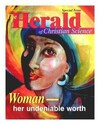
Mary Baker Eddy in the light of womanhood

For many years, the cover of the Christian Science Sentinel pictured a lady with a lamp, bearing the words of Henry Wadsworth Longfellow:

A Lady with a Lamp shall stand,
In the great history of the land,
A noble type of good,
Heroic womanhood.Mary Baker Eddy Mentioned Them (Boston, Mass.: The Christian Science Publishing Society, 1961), p. 160.

Longfellow's poem was a tribute to Florence Nightingale, the English nurse who tirelessly made her rounds, lamp in hand — scrubbing floors, cooking, nursing, saving lives during the Crimean War.

Mary Baker Eddy, too, through her heroic service in the healing of humanity, exemplifies the woman with a lamp. The light Mrs. Eddy held up is one that banishes the darkness of sin, sickness, and death.

Late in the nineteenth century, when Mrs. Eddy was well established as a religious leader and as the discoverer of Christian Science, a young woman from Germany in need of healing went to hear this “Lady Preacher” give a sermon. It was the sheer novelty of hearing a woman speak in public that drew the young woman to the service because in her country women just did not preach.

Seated in the back of the hall, the young woman could not understand a word the preacher said. Yet she later wrote, “... as I listened I experienced an inexpressible feeling of relief, and the pains and misery, with which I had gone to this lecture hall, had fallen away from me.

Not knowing to whom I had been listening, I asked an usher for the name of the ‘Lady Preacher.’ In utter astonishment he looked at me and answered, ‘Why, that was Mrs. Eddy!’— Mrs. Eddy?! I had never heard the name before — I left the hall free and well.” Yvonne von Fettweis and Robert T. Warneck, Mary Baker Eddy, Christian Healer (Boston, Mass.: The Christian Science Publishing Society, 1998), pp. 128-129.

What this young woman experienced can't simply be attributed to being in the presence of a famous woman. The name “Mary Baker Eddy” meant nothing to her. But what she did respond to was the healing touch of Mrs. Eddy's unselfed, pure womanhood — a womanhood that glorified God.

The healing qualities of real, spiritual womanhood have embraced the world from the beginning. In the Bible, both male and female were made to be fruitful, to bless, and to be cared for in God's completely good creation. Commenting on this, Mrs. Eddy wrote, “The ideal man corresponds to creation, to intelligence, and to Truth. The ideal woman corresponds to Life and to Love” (Science and Health, p. 517 ).

The concept of real womanhood hasn't just slowly evolved over the centuries. As an ongoing expression of God, the healing power of mothering has always been present for women and men to treasure and express. Efforts to subjugate woman's work, to underappreciate — or to eradicate altogether the record of women's achievements throughout the ages — must give way to what God has ordained: the spiritually inspired concept of pure womanhood.

Jesus recognized this concept of womanhood. He included women in his healing ministry, even though this defied popular tradition. Bible scholar Bobby Lee Holley explains, “In Jesus' actions and attitudes, in his willingness to come up against the traditions of cultures, in his loving concern, he was revealing the will of God.” Quoted in Women and the New Testament, An Analysis of Scripture in Light of New Testament Era Culture (Jefferson. N.C.: McFarland, 1977), p. 6.

The New Testament gospels paint vivid pictures of the remarkable women who were close to Jesus. Mary Magdalene, for instance, stood in her own light, not as a sinful prostitute, but as a healed woman and a disciple of Jesus. In overflowing gratitude for being freed of severe illness (“seven devils”), she followed Jesus to the foot of the cross and was first to see his resurrection in the morning light. A darkened, material world had lost sight of the true Jesus at that point. But, as Mary Baker Eddy points out in Science and Health, “...the faithful Mary saw him, and he presented to her, more than ever before, the true idea of Life and substance” (p. 314 ).

John's gospel tells the story of two other women Jesus loved: Mary and Martha of Bethany. Outside the kitchen, Mary sat like a male disciple would have in those days — at Jesus' feet — and listened to his teachings. Later on, just before Jesus raised Lazarus from the dead, it was Martha who declared that Jesus is the Christ, the Son of God, who should come into the world (John 11:27 ).

Another remarkable follower of Jesus — a woman who deserves to be appreciated in her own right — appears in Luke's Gospel. Exposing herself to public scorn by approaching Jesus during a meal at Simon the Pharisee's house, she washed Jesus' feet with her tears and wiped them with her loosely flowing hair. Sincerely penitent for past transgressions, this unnamed woman would not be hidden. She exemplified entrance into the light of healing and being healed, forgiving and being forgiven.

Understanding her spiritual nature, Jesus asked Simon, “Seest thou this woman?... Wherefore I say unto thee, Her sins, which are many, are forgiven; for she loved much: but to whom little is forgiven, the same loveth little.” Then Jesus said to her, “Thy sins are forgiven” (Luke 7: 44, 47-48 ).

The woman had apparently been forgiven from the moment she entered the room. Her overflowing tears were those of gratitude and love, not of shame or despair. Her sins, many or few, had fallen away, as from open hands. See Sharon H. Ringe, Luke (Louisville, Ky.: Westminster John Knox Press, 1995), p. 111. And hands like hers will go on to smooth “the pillow of the sick and the heavenly homesick looking away from earth,” Mrs. Eddy suggests in the opening pages of her chapter on “Christian Science Practice” (Science and Health, p. 365 ).

Love of God and compassion for humanity lie at the heart of pure womanhood. Overflowing gratitude, unconditional love, faithful devotion to Christ, pure affection — these are the qualities that comfort the brokenhearted and heal the sick. Mrs. Eddy spent a lifetime exercising these qualities — searching for and finding a spiritual understanding of God as the remedy for all earth's ills. Out of pure love for God and humanity, she came to write the book she had always wanted to write —Science and Health with Key to the Scriptures. This book offers a full explanation of the healing method of Jesus — an explanation that anyone could understand. And, for over a century, this book has brought the light of hope and healing to millions of people.

In her life work, Mary Baker Eddy cherished and expressed the womanly qualities seen in the Biblical portraits of Mary Magdalene, of Martha and Mary from Bethany, and of Mary, Jesus' mother. And Mrs. Eddy's achievements — writing Science and Health, founding a worldwide Church, and much more — show the power of the womanhood she expressed.

This is the end of the issue. Ready to explore further?
January 1, 2001
Contents

We'd love to hear from you!

Easily submit your testimonies, articles, and poems online.

Submit